PSA vs CGC vs BGS: which grading company in 2026?
Three of the four big graders now share one owner, PSA's cheap tiers are paused, and there's an antitrust suit in progress. The state of Pokémon card grading in 2026, with real numbers.
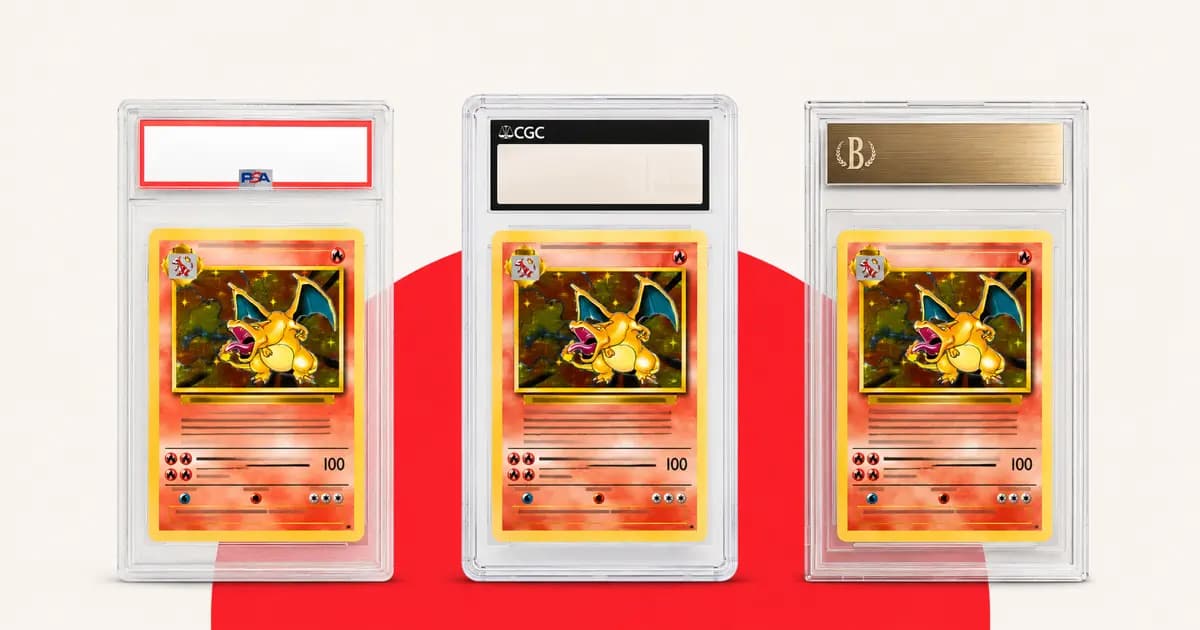
Most "PSA vs CGC vs BGS" articles are written as if you are choosing between four independent companies competing for your business. In 2026 that is no longer true, and it is the single most important thing to understand before you send a card anywhere.
Three of the four big graders now share one owner
Collectors, the parent company of PSA, has spent two years buying its competition:
- PSA, its flagship grading business
- PCGS, coins
- SGC, acquired in February 2024
- Card Ladder, pricing data
- Beckett (BGS), definitive agreement announced 15 December 2025
Using GemRate's figures, as reported by ESPN when the Beckett deal was announced, PSA holds over 75% of the graded-card market, CGC just over 18%, and Beckett around 3%.
Add SGC and Beckett to PSA and one company controls roughly 80% of card grading. When you "shop around" between PSA, BGS and SGC, you are shopping between three brands with the same owner. CGC is the only major grader still independent of Collectors.
Collectors says the brands stay independent. Its announcement on the Beckett deal states there will be "no change in pricing as a part of this acquisition," and CEO Nat Turner framed the company as "custodians of this important icon in the hobby." Whether brand independence survives common ownership is exactly what is now being argued in court.
There is an antitrust lawsuit in progress
On 15 April 2026, Michael Rasmussen filed Rasmussen v. Collectors Holdings, Inc. et al (case 8:26-cv-00897) in the US District Court for the Central District of California.
The complaint alleges violations of Section 7 of the Clayton Act, arguing that Collectors used acquisitions to eliminate competitors and that after buying SGC and Beckett it increased prices and decreased service quality. It seeks treble damages and, notably, forced divestment of SGC and Beckett.
This is an allegation that has not been tested. Collectors had not filed a formal response as of the most recent coverage, and a filed complaint is one side's account. But it is a real case with a real number, and it is worth knowing about before you pick a grader.
What it costs right now
Prices verified directly from each company's own site on 16 July 2026. Grading prices move often, so check before you submit.
PSA
PSA paused all of its Value service levels on 2 June 2026. Its site currently carries a banner reading "Due to extraordinary demand, PSA is temporarily pausing Value services." That removed the affordable end of PSA's range with no announced return date.
| Tier | Price/card | Max insured value | Turnaround |
|---|---|---|---|
| Regular | $79.99 | $1,500 | 40 to 50 business days |
| Express | $149.00 | $2,500 | 20 to 30 business days |
| Super Express | $349.00 | $5,000 | 7 to 10 business days |
| Walk-Through | $599.00 | $10,000 | 5 to 7 business days |
For context, PSA's Value tier was $27.99 before a February 2026 increase took it to $32.99. The cheapest door into PSA is now $79.99, and that is a roughly 2.4x jump on what many collectors were paying at the start of the year.
CGC
| Tier | Price/card | Max value | Turnaround |
|---|---|---|---|
| Bulk (25 min) | $17 | $500 | 120 working days |
| Economy | $20 | $1,000 | 65 working days |
| Standard | $55 | $3,000 | 10 working days |
| Express | $100 | $10,000 | 5 working days |
| WalkThrough | $300 | $100,000 | 2 working days |
Be careful with third-party comparison articles here. Several currently list CGC Bulk at $15 with a 40-day turnaround and Economy at 20 days. CGC's own fee page says $17 and 120 working days for Bulk, and 65 working days for Economy. The gap between the aggregators and reality is months.
The pattern is hard to miss: CGC is dramatically cheaper at the low end, and its fast tiers are both cheaper and faster than PSA's. PSA's premium is not a service premium. It is a liquidity premium.
The buyback problem
In December 2025, a Pokémon collector submitted around 30 identical modern cards to PSA. Most came back PSA 9. He sold them back to PSA through its buyback programme at PSA 9 money, roughly $35 a card.
Checking PSA's public certification database afterwards, he found that 11 of those same certification numbers now showed PSA 10.
Here is where you need to separate what is confirmed from what is alleged, because a lot of hobby coverage does not.
Confirmed: the cards were bought back at 9 money, and the same certs later read 10. PSA and Collectors say this was a grading error caught in an internal quality-control review, which happened after the collector complained publicly, and they deny fraud. Nat Turner responded to collectors on social media, called the problem a "systematic failure," and separately conceded that PSA "authenticates counterfeit cards sometimes."
Alleged, and not established: that PSA deliberately under-grades cards, buys them cheap, and re-grades them upward to resell at a profit as a matter of practice. You will see this stated as fact in forums and Reddit threads. It is not proven, and we are not going to state it as though it were.
You do not need the conspiracy version for this to matter, because the structural problem is real and undisputed: PSA assigns the grade, PSA's buyback offer sets the price it pays you for that card, and PSA does this before any re-review. One company occupies all three roles. That is a conflict of interest whether or not anyone ever abuses it, and it exists by design.
The fallout was real. Collectors and dealers organised boycotts, some retailers halted submissions, and the episode did more damage to trust in grading than any grade-accuracy debate of the last decade.
So which one should you actually use?
If you are selling, PSA still usually wins, and that is the frustrating part. PSA 10 commands the highest resale multiplier because everyone uses PSA, and everyone uses PSA because PSA 10 commands the highest multiplier. The monopoly is self-reinforcing. A CGC 10 typically sells for a meaningful discount to the PSA 10 of the same card. If your goal is maximum sale price on a valuable card, PSA is still the rational choice even if you dislike the company.
If you are grading modern bulk, CGC is the obvious answer. $17 versus $79.99 is not a close call, and with PSA's Value tiers paused there is currently no PSA option that makes economic sense on a $40 card. Budget for the wait.
If you want centering and sub-grades, BGS still does something the others don't. Sub-grades tell you why a card lost points. Just know who owns it now.
If avoiding Collectors matters to you, CGC is your only major option. That is a legitimate reason to pick a grader, and in 2026 it is a short list.
If you want to see the grader's reasoning, look at TAG or Ace. Computer-vision grading with a photographic report showing where points were lost is genuinely more transparent than a number on a label. The resale market for those slabs is much thinner, so treat them as grading for yourself, not for the exit.
Before you submit, wherever you submit
Grading fees are the same whether your card comes back a 6 or a 10, so the prep matters more than the brand. A card with surface grime, a fingerprint under the gloss, or a slight warp is leaving grade points on the table at every company on this list.
That is what we do: careful, conservative work by hand, photographed before and after, with no attempt to hide anything from a grader. If you want to know what actually moves a grade, read how to prepare a Pokémon card for PSA grading, and be honest with yourself about where the line sits between conservation and altering a card.
If you'd rather not risk the prep yourself, start an order and we'll take a look first.
Frequently asked questions
- Is PSA still worth it in 2026?
- For cards you intend to sell, usually yes, because PSA slabs are the most liquid and still carry the highest resale multiplier. That is a statement about the market, not about grading quality. If you are keeping the card, the case for paying PSA's prices is much weaker.
- Are PSA, BGS and SGC really competitors?
- No longer in the ownership sense. Collectors, PSA's parent, acquired SGC in February 2024 and announced a deal for Beckett (BGS) in December 2025. It also owns PCGS and Card Ladder. CGC is the only major grader still independent of Collectors.
- Why can't I use PSA's cheap tiers anymore?
- PSA paused its Value service levels on 2 June 2026, citing demand. The cheapest way in is now Regular at $79.99 per card. The pause has no announced end date.
- Which grader is cheapest for bulk modern cards?
- CGC, by a wide margin, at $17 per card on Bulk (25-card minimum) versus PSA's $79.99 Regular. The trade-off is turnaround, CGC Bulk is quoted at 120 working days, and a lower resale multiplier than an equivalent PSA slab.
Related articles
- How to prepare a Pokémon card for PSA gradingWhat graders actually look at, how to give your card its best shot, and why a clean, flat card can mean a higher grade.
- Can PSA detect if a card has been cleaned or restored?The honest answer, based on PSA and CGC's own standards: yes, grading firms detect cleaning and restoration. Here's how, and why 'undetectable after a few weeks' is a myth.
- How to spot a fake Pokémon card (the tests that actually work)The light test isn't enough anymore, modern fakes pass it. The one principle that beats every checklist, the checks worth doing, and the popular tests that give false positives on real cards.
Guides & tips
PokéRestore →