How to spot a fake Pokémon card (the tests that actually work)
The light test isn't enough anymore, modern fakes pass it. The one principle that beats every checklist, the checks worth doing, and the popular tests that give false positives on real cards.

Counterfeit Pokémon cards have improved fast. The advice that circulated five years ago now clears the bar for a whole category of fakes, and worse, some of it fails genuine cards. If you are about to spend real money, you need checks that still hold up.
The one principle that beats every checklist
Compare the card to a known-genuine card from the same set and the same language.
That single habit is worth more than every test below combined. Print quality, cardstock, gloss, foil pattern, fonts and colour balance have all changed repeatedly across eras, and they differ between English, Japanese and other releases. A universal mental image of what a "real card" looks like will fail you in both directions: you will pass fakes and you will condemn genuine cards.
A cheap common from the same set is the perfect reference. It costs almost nothing and it is the control in your experiment.
The checks that hold up
The rosette check, under a loupe
This is the strongest test available to a normal collector, and almost nothing beats it cleanly.
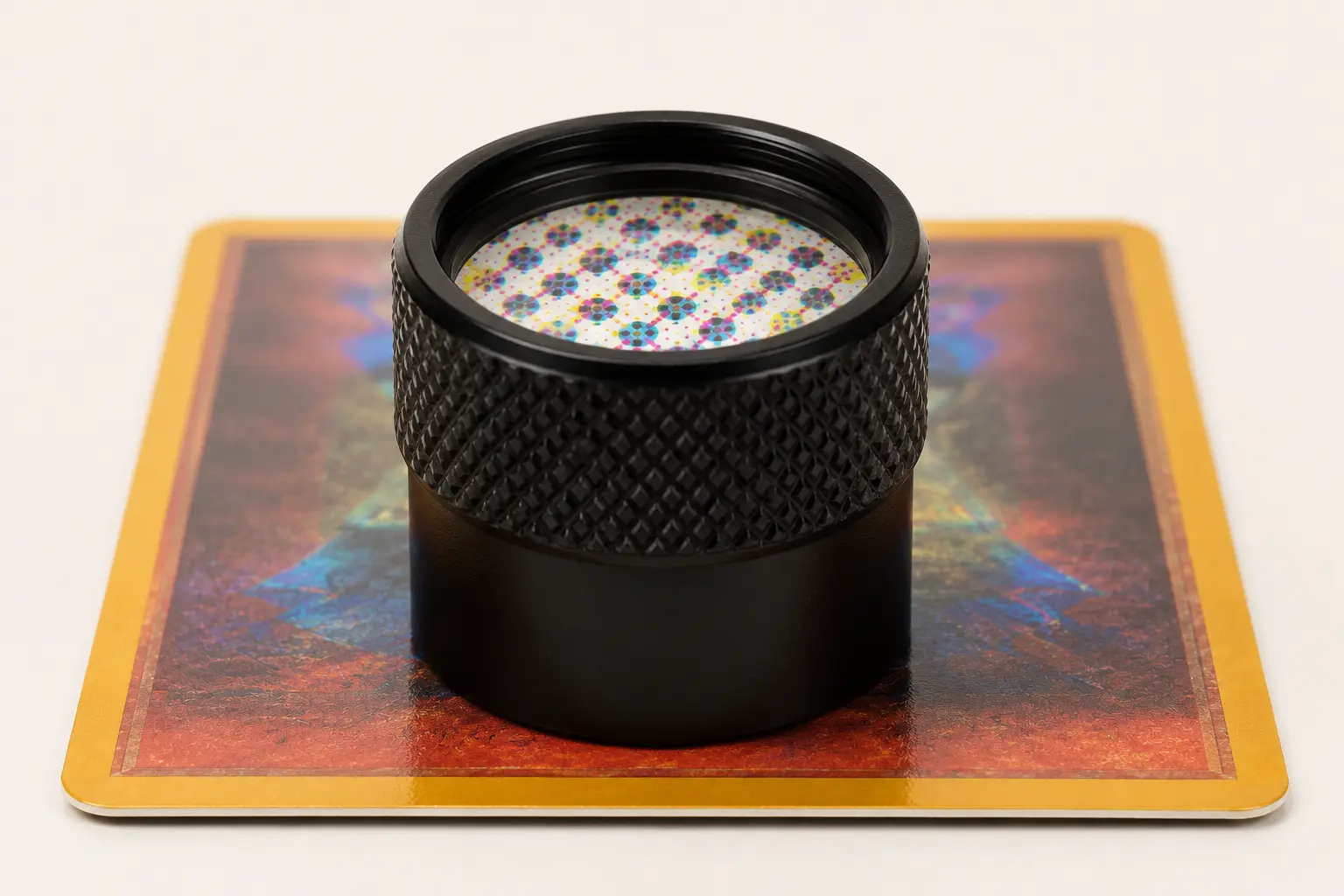
Put a 10x jeweller's loupe on a mid-tone area of the artwork, somewhere the colour is neither solid nor near-white. Genuine cards are offset printed in CMYK, so a mid-tone resolves into a regular, repeating pattern of tiny cyan, magenta, yellow and black dots called a rosette. Each ink is screened at its own angle, and the overlap produces repeating flower-shaped clusters with small open centres.
The yellow border gets recommended a lot for this, and it does show dot structure, but a near-solid colour is where dots merge and the rosette is at its least obvious. A mid-tone shows you all four screens at once.
Fakes are printed on inkjet or laser hardware, which does not work this way at all. Inkjet uses stochastic dithering: droplets of roughly equal size scattered pseudo-randomly, with density rather than dot size carrying the tone. There is no grid, no angle, no rosette.
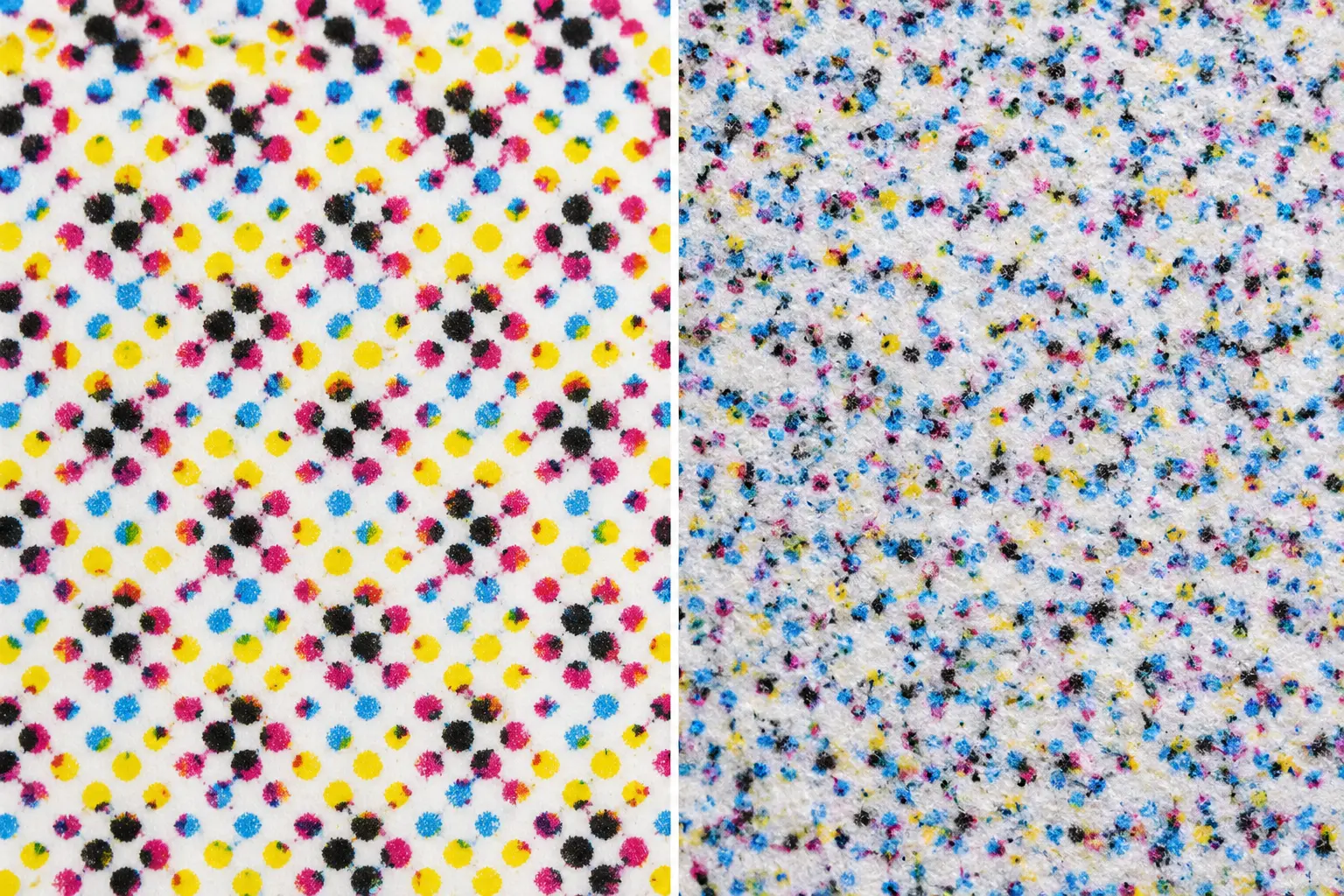
The distinction you are looking for is ordered versus random. Compare against your reference card. If one shows structure and the other shows noise, you have your answer.
A loupe costs a few euros. If you buy cards with any regularity, buy one.
Texture and foil behaviour
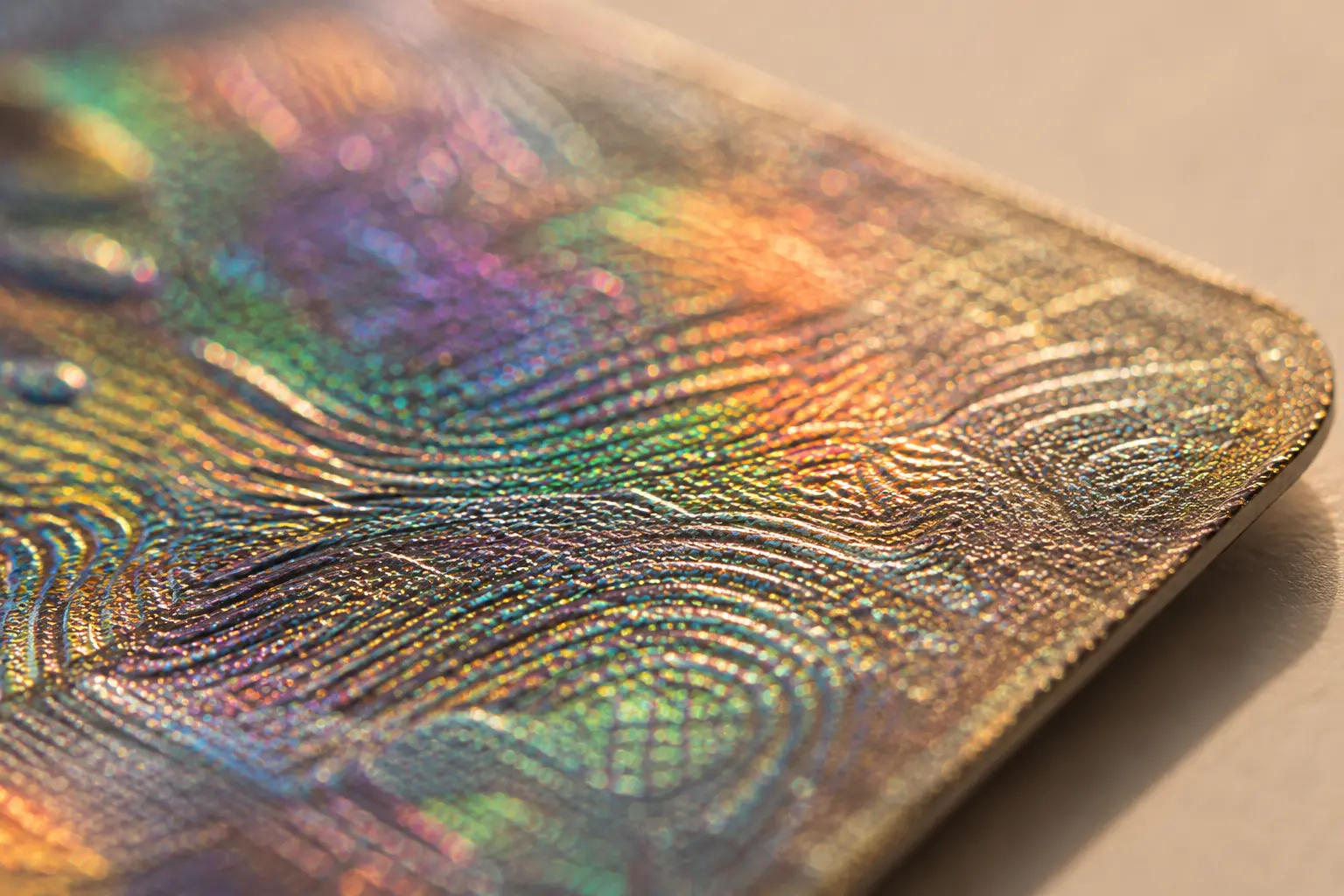
On modern chase cards, texture is embossed and it interacts with the holo underneath. Tilt the card. Real texture changes how light moves across the foil.
A common counterfeit shortcut is to print the texture. It looks right in a photo and dies the moment you tilt it, because printed texture doesn't move light. Fake holos also tend to run flat and simple, and special cards often carry a brownish, yellowish or orange cast.
Fonts and kerning
Counterfeiters rebuild the card layout, and typography is where the rebuild shows. Look for uneven letter spacing, abnormally wide gaps, and letterforms that are subtly the wrong shape or weight. Set your reference card alongside and compare the same word.
Symbols and details
- Energy symbols sitting off-centre in their orbs, or the wrong size or shape
- Set symbols that are wrong, blurry, or from the wrong region entirely
- Missing accents on "Pokémon", a classic tell
- Misspellings in names or attack text
- Absurd HP values, 13000 instead of 130, common on fakes made to impress children
Weight, but comparatively
Modern English cards commonly land around 1.7 to 1.8 grams, and many fakes fall outside that window because they skip a layer or overcompensate.
But treat absolute numbers with caution. Weight varies with era, set and language, and a cheap scale reading to 0.01 g is not as accurate as its display implies. Weigh the suspect against a known-genuine card from the same set. A meaningful difference between two cards that should match is the signal. A number matching a figure you read online is not.
The light test, as a first screen only
Hold the card flat against a phone torch in a dark room. Genuine cards have a dark inner layer sandwiched between the front and back stock, so light should not pass through cleanly.
Here is the problem: modern super fakes add their own black layer and pass this test. Meanwhile some genuine cards, thin older stock, some Japanese cards, look suspicious under it.
So the logic is one-directional. Failing the light test is meaningful. Passing it proves nothing. Use it to bin obvious junk, never to conclude a card is real.
UV, as a signal not a verdict
Under a 365nm UV torch, paper stock and ink chemistry fluoresce differently, and many counterfeits glow noticeably white or blue because they use paper with different optical brighteners.
You will see this test described online as the one that catches everything. It doesn't. A counterfeiter using brightener-free stock defeats it, and genuine cards vary between print runs. Compare against your reference and treat a mismatch as a reason to keep digging, not as proof.
The rip test, and why it's a last resort
Tearing a card shows the layered construction and the dark grey or black inner layer directly. It is definitive and it destroys the card. It only makes sense on a card you have already concluded is fake, or on one worthless enough that the answer is worth more than the card.
The tests that mislead people
- "It feels real." Feel is genuinely useful once you have handled thousands of cards, and worthless before that. Fakes are routinely described as papery or plasticky, but the calibration only comes with volume.
- The light test alone. Covered above. It is the single most over-trusted check in the hobby.
- Absolute weight figures. Off by set and era, and beyond the accuracy of most scales.
- UV as proof. A useful signal, not a verdict.
- A single test of any kind. No individual check settles it. Genuine cards fail individual tests and good fakes pass them. Stack several, and always against a reference.
Red flags before you even inspect
Most fakes are caught at the listing, not under a loupe. Sealed product priced well under market, booster boxes advertised as full of chase cards, "Pokémon GO" branding where TCG branding belongs, Japanese set markers on a card sold as English, Pokémon evolving from the wrong species, or a stock photo instead of the actual card. If the deal only makes sense when the card is fake, it usually is.
What about graded cards?
A slab dramatically raises the odds that a card is genuine, and for most buyers that is the practical answer to the whole problem.
It is not absolute, though. Collectors CEO Nat Turner publicly conceded that PSA "authenticates counterfeit cards sometimes," which is a remarkable admission from the company that has the most to lose from it. If you want the wider picture on who grades what and who owns whom, we covered it in PSA vs CGC vs BGS: which grading company in 2026.
One last thing, from our side of the bench
We get asked to clean and restore cards that turn out to be counterfeit, and it is a wasted job every time. A fake has no grade to protect and no value to preserve, and restoration work on one costs more than the card.
Check first. If the card is genuine and it is dirty, warped or grimy, that is a different conversation, and one worth having: read how to clean Pokémon cards safely, or start an order and we'll tell you honestly what we think it needs, including when the answer is nothing.
Frequently asked questions
- Does the light test still work on fake Pokémon cards?
- Only as a first screen. Real cards have a dark inner layer that blocks light, and cheap fakes glow through. But counterfeiters now add their own black layer, so a card passing the light test proves nothing. Failing it is meaningful, passing it is not.
- How much does a real Pokémon card weigh?
- Modern English cards are commonly around 1.7 to 1.8 grams, but weight varies by era, set and language, and most kitchen scales aren't accurate enough to split hairs. Weigh your suspect card against a known-genuine card from the same set rather than trusting an absolute number.
- What is the most reliable way to check a Pokémon card?
- A 10x jeweller's loupe on a mid-tone area of the artwork. Genuine cards are offset printed in CMYK and resolve into a regular rosette of cyan, magenta, yellow and black dots, each ink screened at its own angle. Inkjet fakes show pseudo-random scattered droplets with no grid and no rosette. You are looking for ordered versus random.
- Can a fake card get graded by PSA?
- It can happen. Collectors CEO Nat Turner publicly conceded that PSA 'authenticates counterfeit cards sometimes.' A slab raises the odds a card is genuine considerably, but it is not an absolute guarantee.
Related articles
- PSA vs CGC vs BGS: which grading company in 2026?Three of the four big graders now share one owner, PSA's cheap tiers are paused, and there's an antitrust suit in progress. The state of Pokémon card grading in 2026, with real numbers.
- Can PSA detect if a card has been cleaned or restored?The honest answer, based on PSA and CGC's own standards: yes, grading firms detect cleaning and restoration. Here's how, and why 'undetectable after a few weeks' is a myth.
- How to clean Pokémon cards safely (without ruining them)A careful, step-by-step guide to removing dirt, grime and residue from Pokémon cards before grading, and the mistakes that damage cards for good.
Guides & tips
PokéRestore →