How Much Is My Pokémon Card Worth? A Practical Value Guide
Identify the exact Pokémon card, compare recent sales in the right language and condition, and estimate a realistic raw or graded value.
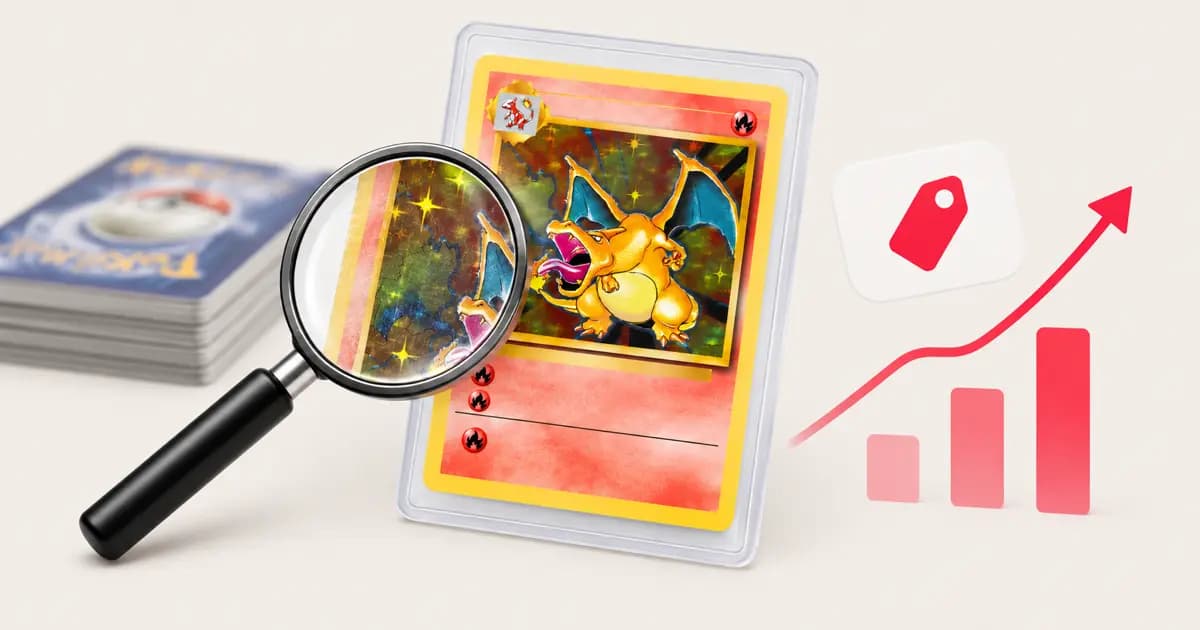
The quickest way to get a misleading Pokémon card value is to search the character name and copy the biggest price you see. The exact card, printing, language, condition and sale date all matter. This guide gives you a repeatable way to estimate a realistic value before you sell, insure or consider grading a card.
Step 1: Identify the exact card
Start with the set symbol or set name, collector number, card name, rarity and language. Then check for details that change the version:
- Holo, reverse holo, non-holo or another foil pattern
- First Edition, Unlimited, promo stamp or special release
- Alternate artwork, illustration rare or other variant
- English, Japanese, French or another language
- Authentic card versus a counterfeit or misidentified printing
Use the number near the bottom of the card and compare the artwork and symbols with a reliable set checklist or marketplace catalogue. The same Pokémon name can have many printings with very different prices.
Step 2: Assess condition honestly
Inspect the corners, edges, surface and structure under diffuse light. Look for whitening, holo scratches, dents, bends, stains, creases and water damage. A clean surface does not cancel out edge wear; a sharp-looking front does not tell you what the back looks like.
Marketplace labels such as Near Mint, Lightly Played or Damaged are not identical everywhere. Follow the relevant marketplace's own condition guide, and use our Pokémon card condition guide for a practical inspection checklist.
For a raw card, compare it with sold examples in the same condition. Do not price it as Near Mint if visible flaws would move it into a lower category.
Step 3: Compare recent completed sales
Search for the exact version and filter to sold or completed transactions. Compare several examples from the recent past rather than relying on one unusual sale. Marketplaces and price tools use different data; for example, TCGplayer explains that its Market Price is based on recent completed sales, while its Most Recent Sale is just one transaction.
When comparing sales, match as many details as possible:
- Same card number and printing, including foil variant.
- Same language and whether the card is raw or graded.
- Similar condition or the same grading company and grade.
- Similar sale date and currency.
- Comparable shipping and seller fees.
Treat active asking prices as context, not proof of value. A listing can remain unsold at an unrealistic price. For Europe, Cardmarket provides a Pokémon catalogue and price guide; TCGplayer and completed-sale tools may be useful for other markets. Prices can differ by region because of supply, demand, language preference and shipping.
Step 4: Separate raw and graded prices
A raw card's price is not the same as the price of a professionally graded copy. If you are considering grading, compare recent sales for that exact card at several realistic grades, then subtract grading, shipping, insurance and selling fees. Also consider the chance that the final grade may be lower than your estimate.
PSA notes that grading decisions consider details such as corners, edges, surface and centering. A home inspection can help you decide whether grading merits research, but it cannot guarantee a grade. Read our guide to PSA, CGC and BGS before choosing a service.
Step 5: Consider the card's net value
The amount you receive can be lower than the headline sale price. Account for marketplace fees, payment fees, postage, insurance and possible discounts for condition. A card that appears valuable in a high-grade listing may not be worth grading if the raw copy has visible wear or the likely grade does not cover the costs.
Avoid adding a speculative premium for potential restoration. Cleaning may remove removable dirt or residue, but it cannot undo whitening, scratches, dents or creases. Read whether to restore a card before grading before making that decision.
A simple value checklist
- Identify the exact set, number, variant and language.
- Confirm the card is authentic.
- Record condition flaws and photograph them clearly.
- Find several recent completed sales for matching copies.
- Keep raw and graded comparisons separate.
- Subtract transaction, grading and shipping costs from expected proceeds.
- Recheck prices shortly before listing; collectibles markets move.
If a mark or warp is making the condition hard to judge, have the card assessed before deciding whether to sell it raw or submit it for grading. A realistic condition description is more useful than an optimistic estimate.
Sources: TCGplayer: Market Price and recent sales · Cardmarket Pokémon price guide · PSA grading standards
Frequently asked questions
- How do I find out what a Pokémon card is worth?
- Identify the exact card and printing, assess its condition, then compare several recent completed sales for the same language, variant and condition. Asking prices alone do not show what buyers actually paid.
- Does a high asking price mean my Pokémon card is valuable?
- No. An unsold listing shows what a seller hopes to receive, not what the market has paid. Use multiple recent sold examples and account for condition, shipping and fees.
- Should I grade a valuable Pokémon card?
- Compare realistic graded sale prices by grade with the raw-card value, grading and shipping costs, and the chance of receiving each grade. Do not assume that cleaning or grading will increase the card's net value.
Related articles
- Pokémon Card Condition Guide: Near Mint, LP, MP, HP & Damaged ExplainedLearn how to inspect Pokémon card corners, edges, surfaces and bends, and what common condition labels mean when buying or selling.
- PSA vs CGC vs BGS: which grading company in 2026?Three of the four big graders now share one owner, PSA's cheap tiers are paused, and there's an antitrust suit in progress. The state of Pokémon card grading in 2026, with real numbers.
- Should you clean or restore a card before grading?When cleaning and restoration help a Pokémon card's grade, when they don't, and where the honest line is between conservation and altering a card.
Guides & tips
PokéRestore →