Do holographic foil wax products actually work?
Wax, oil and 'holo revival' sprays promise to feed and restore a card's shine. Based on how holographic foil actually works, here's what they really do to your card.
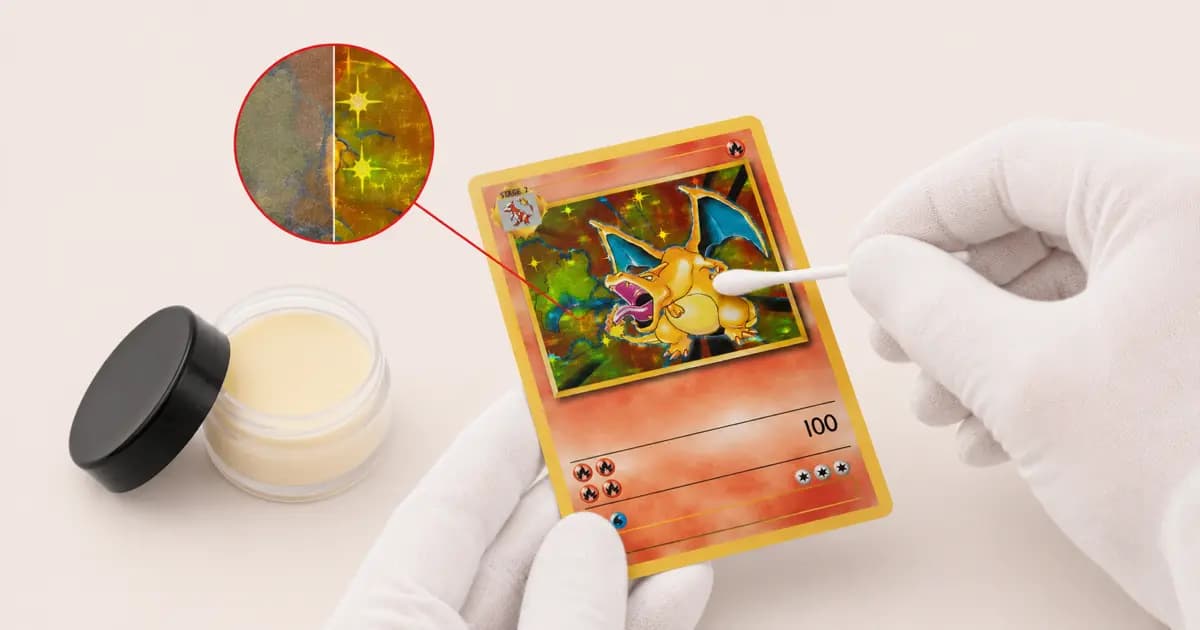
Search for holo card restoration and you'll find waxes, oils and sprays that promise to "feed the foil," "revive the shine" or "restore" a dull holographic surface. They look convincing in before-and-after clips. So do they work? The honest answer, based on how the foil is actually built, is no, not in the way they claim.
A hologram isn't a material you can feed
The rainbow effect on a holo card doesn't come from a coating you can top up. It comes from a microscopic diffractive structure, a physical relief of ridges and a reflective metal layer, that bends light into those colours. It's a shape, not a substance.
That's why the word "feed" is misleading. A hologram is not oil-based or dry-and-thirsty. You can't replenish it. If the shine is gone because the relief is scratched, the metal layer is damaged, or the foil has delaminated, no liquid puts that structure back. The geometry that made the rainbow is simply gone.
What the wax is actually doing
When a wax or oil makes a holo look better on camera, here's what's really happening:
- It deposits a thin film over the surface, giving a temporary wet, glossier look.
- It fills fine scratches, so they scatter less light for a while.
- It changes the optical boundary of the surface, which is why the "shine" shifts.
None of that restores the diffraction structure. It masks the surface by sitting on top of it. And a film that sits on top has consequences: it holds dust, it can migrate and wick toward edges, it changes how the surface feels, and removing it later means yet another solvent exposure on a delicate card.
Polishes and plastic compounds are worse. They "reduce scratches" by abrasion, which means they remove or roughen the original surface, and on a holo that's the exact layer you don't want to touch.
The part that matters for grading
Every one of these products, wax, oil, silicone, polish, resin or coating, is a foreign layer added to the card. That makes it detectable, and grading firms treat added surface substances as alteration. So a waxed holo isn't just temporarily glossy, it's a card a grader can flag.
So what actually helps?
Two honest cases:
- The dullness is a contaminant. A fingerprint film or light grime can genuinely dull a holo, and removing it, carefully, by hand, brings back the real shine that was hidden. That's conservation, and it's undetectable because you added nothing.
- The dullness is physical loss. Scratched relief, lost metal, delamination. This can't be "restored" by any product. The most a treatment can do is deposit a film that masks it.
That difference, removable dirt versus physical loss, is the whole game.
How we approach it
Our grading-safe treatment only ever removes proven contaminants, so a genuinely dirty holo comes back brighter with nothing added and nothing for a grader to find. Our full treatment can go further for private display, including finishing that visibly lifts a tired holo, but because that adds a layer, it's for cards you're keeping, not grading. We tell you up front which one a card needs, and we never sell a "revival" that's really just wax.
Curious what's actually recoverable on your card? Start an order and we'll assess the holo before touching it, or read can PSA detect a restored card? to see why the wax route backfires at grading.
Related articles
- Are Pokémon card cleaning sprays safe?'Safe' cleaning sprays for trading cards are everywhere. Based on how cards are actually built, here's the risk they carry and why there's no honest universal formula.
- Can PSA detect if a card has been cleaned or restored?The honest answer, based on PSA and CGC's own standards: yes, grading firms detect cleaning and restoration. Here's how, and why 'undetectable after a few weeks' is a myth.
- How to clean Pokémon cards safely (without ruining them)A careful, step-by-step guide to removing dirt, grime and residue from Pokémon cards before grading, and the mistakes that damage cards for good.
Guides & tips
PokéRestore →