Are Pokémon card cleaning sprays safe?
'Safe' cleaning sprays for trading cards are everywhere. Based on how cards are actually built, here's the risk they carry and why there's no honest universal formula.
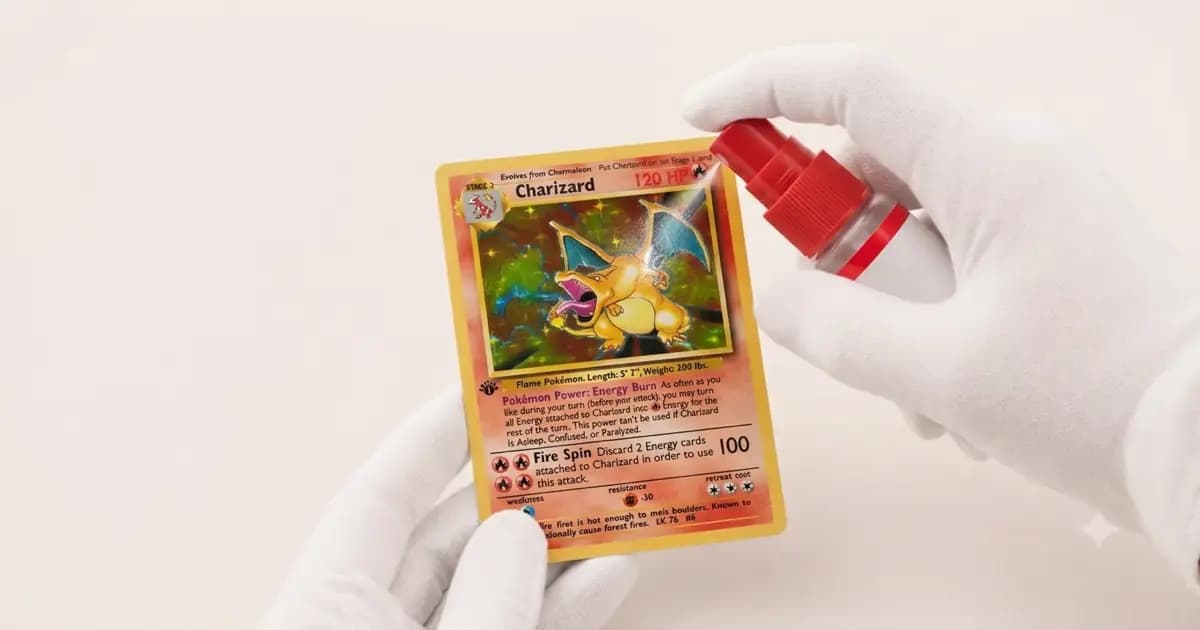
There's a whole market of sprays and solutions sold as the safe way to clean trading cards. They promise to lift fingerprints, grime and haze without harming the card. Are they safe? The honest answer is that there is no scientifically supported universal cleaning liquid for Pokémon cards, and treating any spray as "safe for all cards" is how good cards get quietly ruined.
Why "one safe spray" can't exist
A Pokémon card isn't one material. It's a stack: paper core, print inks, a surface varnish, and on holos a foil layer with its own adhesive. Each of those reacts differently to liquid, and the exact chemistry varies by era, set and print run. A solvent that's harmless to one layer can attack another.
That's the core problem with a universal spray: it has to be safe for every layer of an unknown composite, at every edge, on every era of card. Nothing on the market is proven to do that. Chemical-resistance data for a plastic sheet tells you nothing about an unknown print varnish, ink, or foil adhesive in an assembled card.
What actually goes wrong
The failure modes are specific and often irreversible:
- Water wicks into edges. Cardboard swells and warps, and once moisture is in the core the damage is permanent.
- Alcohol and solvents lift ink and dull gloss. They can disturb the surface coating and any earlier repair.
- Surfactants and "gentle" additives leave residue. They're deliberately non-volatile, so they don't evaporate, they stay on the surface. That's exactly what a grader reads as a foreign substance.
- A spray jet drives soil into edges and can leave a tide line as it dries.
The worst part is that a lot of this is subtle at first. The card looks cleaner immediately, and the damage, a faint haze, a slightly swollen edge, a residue only visible under angled light, shows up later.
"But I'll spot-test it first"
A quick dab on a corner isn't a real safety test. It may look fine and still be irreversible, it won't represent how the foil or a cut edge reacts, and by the time you can see a problem it's already done. Professional conservators test on sacrificial equivalents, not on the card that matters, precisely because a spot test on the real card is itself a risk.
The safest DIY answer
For loose dust, no spray at all: gentle, no-contact air and a soft dry brush. For anything more stubborn, fingerprints, films, sticky residue, the safest home decision is to not put a liquid on the card yourself. That's not us being dramatic, it's the lowest-risk option for a card with real value.
What we do instead
We don't sell a magic spray, because there isn't one. We clean by hand with controlled, conservation-grade technique, matched to the specific card in front of us, with photos before and after. And every card carries the choice between grading-safe work, which stays fully conservation-grade and leaves nothing a grader could flag, and full work for private collections where aesthetics come first.
If a card is dirty enough that you're reaching for a spray, that's exactly the card worth having assessed first. Start an order, or read how to clean Pokémon cards safely for the at-home basics that won't backfire.
Related articles
- How to clean Pokémon cards safely (without ruining them)A careful, step-by-step guide to removing dirt, grime and residue from Pokémon cards before grading, and the mistakes that damage cards for good.
- Do holographic foil wax products actually work?Wax, oil and 'holo revival' sprays promise to feed and restore a card's shine. Based on how holographic foil actually works, here's what they really do to your card.
- Can PSA detect if a card has been cleaned or restored?The honest answer, based on PSA and CGC's own standards: yes, grading firms detect cleaning and restoration. Here's how, and why 'undetectable after a few weeks' is a myth.
Guides & tips
PokéRestore →